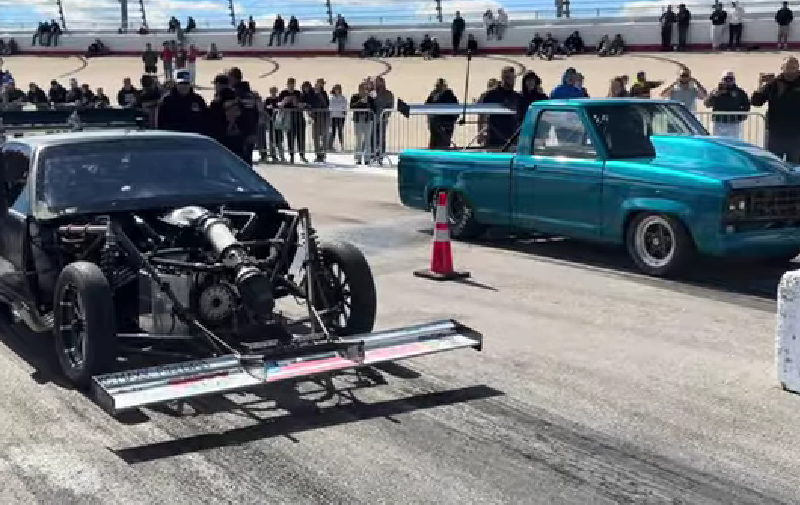
Take a look how Small Tire No Prep Racing Gets WILD at Pulaski County Motorsports Park as Drivers Battle for Traction!!
Massive horsepower, unpredictable launches, and an unforgiving racing surface create an exciting combination as small-tire drag racing machines take on the no-prep challenge at Pulaski County Motorsports Park.
There’s nothing quite like small-tire no-prep drag racing. When high-horsepower race cars line up on a surface that offers limited traction, every launch becomes a battle between engine power, chassis setup, and driver skill.
That’s the excitement behind the video “SKETCHY SMALL TIRE NO PREP ACTION!!! PULASKI COUNTY MOTORSPORTS PARK NO PREP,” which highlights the unpredictable nature of this increasingly popular form of grassroots motorsports.
Unlike conventional drag racing, where the track is carefully prepared to help cars accelerate, no-prep competition forces racers to work with the grip available beneath their tires.
The result is a racing environment where even the fastest car can struggle to make a clean pass.
Pulaski County Motorsports Park Provides an Unusual Racing Setting
Located in Virginia, Pulaski County Motorsports Park has a long history in American motorsports.
Formerly known as Motor Mile Speedway and New River Valley Speedway, the facility has hosted a variety of racing competitions, including NASCAR-related events, the Superstar Racing Experience, and regional stock car racing.
The venue is primarily known for its paved oval, making it an interesting setting for the no-prep action featured in the video.
While traditional drag strips are purpose-built for straight-line acceleration, no-prep events can introduce competitors to surfaces that demand very different tuning strategies.
And when small-tire cars enter the equation, the challenge becomes even greater.
Small Tire No Prep Racing Is All About Controlling Horsepower
One of the biggest attractions of small-tire racing is the enormous amount of power competitors attempt to transfer through a relatively narrow rear tire.
Depending on the event rules, these cars may run tires such as 28×10.5-inch slicks or comparable drag radials.
That limited contact patch creates a difficult balancing act.
A powerful engine can produce far more torque than the racing surface can support, especially during the initial launch.
If the driver applies too much power too quickly, the rear tires can spin violently, costing valuable acceleration and potentially causing the car to move out of its intended path.
That’s why successful no-prep racing requires much more than simply building the most powerful engine.
The best teams understand how to manage horsepower and make their suspension systems work with the available traction.
Sketchy Racing Conditions Keep Drivers on Their Toes
The word sketchy has become almost synonymous with no-prep racing.
It describes those unpredictable moments when a race car begins struggling for traction, moves around on the racing surface, or forces the driver to make rapid corrections.
Unlike heavily prepared tracks, where racers can often rely on consistent grip, no-prep surfaces may change significantly between passes.
Temperature, dust, existing rubber, and track condition can all influence traction.
This makes each race a new challenge.
A setup that works perfectly during one pass might become too aggressive during the next.
For spectators, that unpredictability is a major part of the entertainment.
For drivers, it demands concentration and respect for the racing surface.
Why Small Tire Racing Can Be More Exciting Than Big Tire Competition
Big-tire drag racing machines are capable of extraordinary acceleration, but small-tire cars introduce another layer of difficulty.
With less available traction, drivers often have to manage power more carefully.
This creates opportunities for racers who might not have the most expensive engines or the highest horsepower figures.
A well-balanced combination with an effective suspension setup can outperform a more powerful machine that struggles to hook.
Many grassroots no-prep competitions also restrict wheelie bars and specify tire-size limits, further increasing the importance of chassis tuning.
The result is a form of racing where experience, preparation, and consistency can be just as valuable as outright speed.
Every Launch Can Make or Break the Race
The first few feet of a no-prep drag race are often critical.
A strong launch can give a driver an immediate advantage, but applying too much power can ruin the entire pass.
Teams must carefully consider tire pressure, suspension settings, shock adjustments, and engine power delivery before approaching the starting line.
For turbocharged combinations, boost management plays an important role.
Nitrous-powered cars require careful control of when and how additional power is introduced.
Supercharged engines present their own challenges because of their aggressive power characteristics.
Regardless of the combination, the objective remains the same: deliver as much usable horsepower as possible without overwhelming the tires.
Grassroots No Prep Racing Continues to Attract Fans
One of the reasons no-prep drag racing has developed such a dedicated following is its connection to traditional street-style competition.
The cars are powerful, the racing is heads-up, and the conditions often leave little room for mistakes.
Fans enjoy watching drivers and tuners solve problems in real time.
Every matchup becomes a test of preparation and adaptability rather than simply a contest of horsepower.
Events across the country have demonstrated the popularity of small-tire racing, with competitors battling for prize money, trophies, and bragging rights.
And when the racing surface is particularly challenging, the competition becomes even more unpredictable.
Pulaski County No Prep Racing Shows Why Traction Matters More Than Power
The small-tire no-prep action associated with Pulaski County Motorsports Park represents the kind of racing that continues to capture the attention of drag racing enthusiasts.
It’s not just about building a car capable of producing incredible horsepower.
It’s about figuring out how to use that power when the racing surface refuses to cooperate.
From difficult launches to the constant challenge of maintaining traction, small-tire no-prep competition delivers a distinctive kind of excitement.
For fans of Street Outlaws-style racing, grassroots drag racing, and high-horsepower small-tire machines, this is exactly the type of motorsports action that makes no-prep events so appealing.