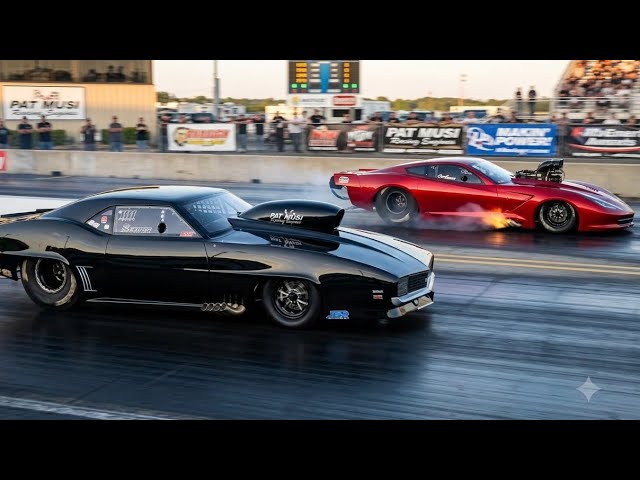
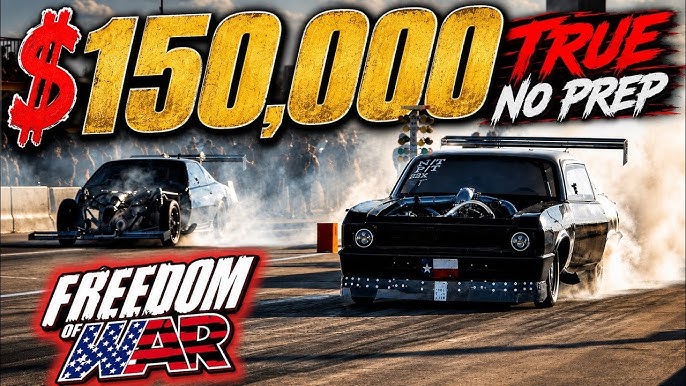
Take a look at this, Street Outlaws Invade US 131: Ryan Martin and Murder Nova Battle on Michigan’s Fastest Track!
When some of the biggest names in outlaw drag racing roll into US 131 Motorsports Park in Martin, Michigan, expectations are always high. This time, the competition delivered exactly what fans wanted: brutal acceleration, 200-plus-mph passes, razor-thin margins and several races decided by what happened at the starting line.
Ryan Martin and Shawn “Murder Nova” Ellington were among the headline names, but the biggest story was just how competitive the entire field had become.
According to the commentary, only around four hundredths of a second separated the No. 1 and No. 16 positions.
That meant there were essentially no easy rounds.
A slight hesitation on the tree, a small loss of traction or a car moving around down track could instantly end a racer’s weekend.
Murder Nova Takes a Shot at the Tree
Shawn Ellington came out ready to attack.
Murder Nova recorded a .028 reaction time and followed it with approximately a 3.64-second pass. In a field where so many cars were separated by hundredths, that kind of starting-line performance could make all the difference.
But Ellington’s day would eventually take a difficult turn.
Later in the racing, Murder Nova suffered what the announcers described as an absolute “swing and a miss” on the starting line. He couldn’t recover the lost ground and finished the run at approximately 3.71 seconds and 200 mph.
Against cars consistently running deep into the 3.60s, that was simply too much ground to make up.
It was another reminder that even one of the most recognizable and experienced racers in Street Outlaws competition isn’t safe when the field is this quick.
Ryan Martin Shows Championship-Level Speed
Ryan Martin, meanwhile, continued to demonstrate why he is so dangerous whenever championship pressure enters the equation.
Early in the action, Martin produced a strong run in the neighborhood of 3.62 seconds, keeping himself firmly in contention.
But his later performance was even more impressive.
Despite being behind his opponent on the starting line, Martin reportedly charged through with approximately a 3.606-second pass at 209 mph.
That’s serious horsepower.
Martin’s ability to make up ground down track showed just how strong his combination was at US 131. When a driver can overcome a reaction-time disadvantage against this level of competition, the car is clearly working.
200 MPH Becomes Almost Routine
One of the most impressive aspects of the racing was how frequently the scoreboard showed speeds above 200 mph.
Runs around 3.61, 3.62, 3.64 and 3.66 seconds appeared throughout the event, often accompanied by trap speeds between roughly 200 and 209 mph.
Jacob McNeal was among those producing strong numbers, recording approximately a 3.64 at 205 mph before another run in the 3.61-second range was discussed.
Other competitors weren’t far behind.
Gargas produced approximately a 3.62 at 206 mph, while another pass came in around 3.61 at 208 mph.
At those numbers, races aren’t being decided by tenths anymore.
They’re being decided by hundredths—and sometimes thousandths.
Ryan Hayward Cuts an Incredible .003 Light
Perhaps one of the most impressive starting-line moments came from Ryan Hayward.
Hayward recorded an incredible .003 reaction time before running approximately 3.66 seconds.
A light that close to perfect can completely change a race.
When two cars have nearly identical performance potential, reaction time effectively becomes additional horsepower. Leaving just a few hundredths ahead can create a gap that the opponent may never be able to recover before the finish line.
That became a recurring theme throughout the US 131 action.
Peter Norton Wins a Race Separated by Thousandths
One of the closest battles came when Peter Norton and Jason Lee lined up.
Norton was approximately .017 on the starting line and ran a 3.617, while Lee reportedly went .034 and produced a nearly identical 3.619.
The difference in elapsed time was almost nonexistent.
The starting line made the difference.
It’s exactly the type of side-by-side drag racing fans want to see: two incredibly fast cars charging toward the finish line with almost nothing separating them.
Wes Di Stefano Scores a Big Upset
Another notable moment came when Wes Di Stefano defeated Paige Coughlin.
Di Stefano advanced into the next round with another competitive mid-3.60-second performance, proving once again that reputation alone doesn’t guarantee anything when the field is this close.
Coughlin’s team remained confident in its performance, with the commentary suggesting they were determined to continue producing 3.60-second passes regardless of the changing density altitude.
That confidence speaks volumes about how far these cars have progressed.
Running a “six” is no longer necessarily an extraordinary pass for the elite teams—it can be what you need simply to survive a round.
There Were No Easy Opponents at US 131
Perhaps the best description of the entire event came right at the beginning.
The announcers struggled to choose a favorite because there simply wasn’t an obvious weak spot in the ladder.
When the quickest and slowest qualifiers are separated by roughly four hundredths, conventional qualifying positions become far less important.
The No. 16 car can legitimately beat the No. 1 car.
A driver can run 200-plus mph and still lose.
A 3.64-second pass might look spectacular on paper and still send someone back to the trailer.
That’s what makes this level of outlaw drag racing so entertaining.
Ryan Martin Leaves Another Warning for the Competition
Ryan Martin’s approximately 3.606-second, 209-mph blast was arguably one of the biggest statements of the action.
While Murder Nova experienced the cruel side of ultra-close drag racing, Martin demonstrated how dangerous his program can become when the car is making clean passes.
But the bigger story wasn’t simply Ryan Martin versus Murder Nova.
It was the depth of the entire field.
Peter Norton, Jason Lee, Wes Di Stefano, Ryan Hayward, Jacob McNeal and several others showed enough speed to make every round unpredictable.
US 131 delivered exactly what its reputation suggests: extremely fast drag racing where there is almost no room for error.
When cars are consistently running in the low-to-mid 3.60s at more than 200 mph, reaction time, tuning and execution become everything.
And with Ryan Martin showing 3.60-flat potential at nearly 210 mph, the rest of the competition has been warned.