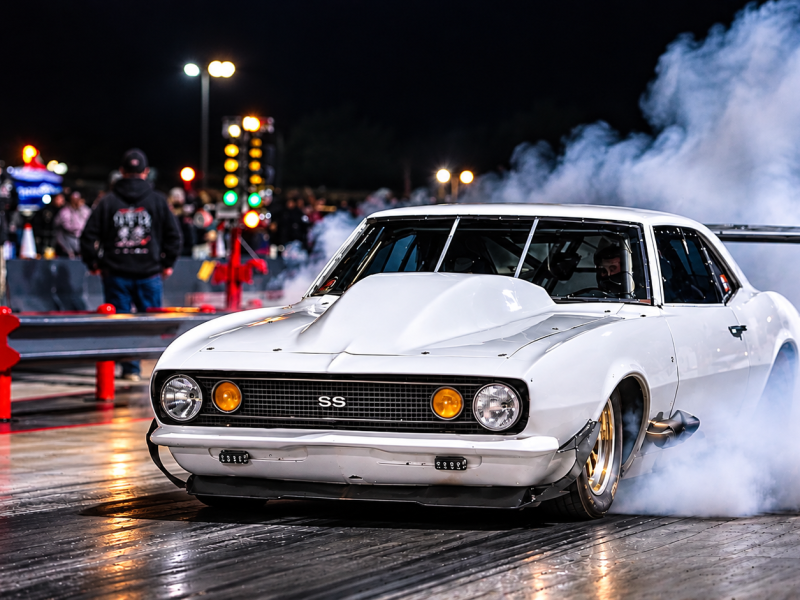
Take a look at this, Joel Grannas Shatters Stick-Shift World Record With Compressed-Air 2JZ Mustang!
Joel Grannas has rewritten the H-pattern drag racing record books at the 2026 World Cup Finals, running an incredible 6.274-second quarter-mile at 230.57 mph in his Toyota 2JZ-powered Fox-body Mustang. Even more astonishing, the record-setting machine uses compressed-air supercharging instead of a conventional turbocharger.
The 2026 World Cup Finals delivered an unforgettable moment in drag racing history when Joel Grannas unleashed his radical Toyota 2JZ-powered Ford Mustang and established a new H-pattern manual-transmission world record.
Competing at Maryland International Raceway, Grannas recorded an astonishing 6.274-second quarter-mile pass at 230.57 mph, proving that his unconventional compressed-air supercharging system could compete with the fastest traditional turbocharged combinations in the world.
What makes the achievement extraordinary isn’t simply the elapsed time. It’s how Grannas produced the horsepower.
Instead of relying on a massive turbocharger, his Fox-body Mustang, known as Peeled, uses high-pressure compressed air to supply boost to its 2JZ engine.
The result is one of the most innovative combinations currently competing in drag racing.
Two World Records Fall Within Minutes
The Stick Shift category at the World Cup Finals was already shaping up to be one of the most competitive in event history.
During qualifying, Brett LaSala and Nick Cole-Mann exchanged record-setting performances.
LaSala initially recorded a 6.320-second pass at 235.49 mph before Cole-Mann responded with a 6.306 at 231.95 mph in his twin-turbocharged Chevrolet S10.
But the biggest drama came during eliminations.
In the opening round, LaSala lowered the elapsed-time record to 6.280 seconds at 230.65 mph.
His achievement barely had time to settle into the record books.
Less than five minutes later, Joel Grannas launched his compressed-air-powered Mustang and stopped the clocks at 6.274 seconds.
That made Grannas the new H-pattern world record holder.
For fans watching the competition unfold, it was an extraordinary demonstration of just how rapidly stick-shift drag racing technology is advancing.
What Is Compressed-Air Supercharging?
The most fascinating part of Grannas’ record-setting Mustang is its unusual power-adder system.
Traditional turbocharged engines use exhaust gases to spin a turbine, which drives a compressor that forces additional air into the engine.
Grannas decided to approach the problem differently.
His Compressed Air Supercharging system, commonly abbreviated CAS, stores highly pressurized air in dedicated bottles and delivers it to the engine when required.
Instead of waiting for a turbocharger to build boost, the system can supply pressurized air almost immediately.
For a high-horsepower manual-transmission race car, that offers several potential advantages.
One of the biggest challenges with a large turbocharger is generating sufficient boost at the starting line.
Grannas previously explained that producing approximately 2,800 horsepower with his relatively small-displacement engine required a very large turbocharger.
That combination forced the team to launch at approximately 6,000 rpm to build the necessary boost.
With compressed-air supercharging, the team can deliver around 30 psi of boost on demand without depending on turbocharger spool-up.
The compressed air is also relatively cool and dense, providing another potential performance advantage.
Why Compressed Air Could Change Stick-Shift Racing
Manual-transmission drag racing creates challenges that automatic-transmission racers don’t experience in the same way.
During a gear change, engine load and exhaust flow can change significantly.
In a turbocharged combination, those changes can affect boost pressure and power delivery.
A compressed-air system offers a different approach because the pressurized air is stored rather than generated by an exhaust-driven compressor during the run.
This allows the team to control the supply of boost independently of turbocharger speed.
For Grannas, that flexibility was particularly attractive.
His Mustang uses a high-performance Toyota 2JZ engine, a platform renowned for its ability to withstand extraordinary horsepower.
But producing extreme power from a relatively small engine requires careful management of airflow, fuel delivery, ignition timing, and drivetrain loads.
The compressed-air arrangement gives Grannas another tool for controlling the engine’s output.
And the 6.274-second record suggests the concept has serious potential.
Meet Peeled: The 2JZ-Powered Fox-Body Mustang
Grannas’ record-setting machine is a purpose-built Fox-body Ford Mustang known as Peeled.
Although the car wears an American body, its engine comes from one of Japan’s most famous performance platforms: Toyota’s legendary 2JZ.
The combination reflects the spirit of the World Cup Finals, where import and domestic technologies regularly come together in unexpected ways.
Before developing the Mustang, Grannas competed with his famous Toyota Supra, Orange Man Bad.
That car helped establish him as one of the leading figures in H-pattern drag racing.
However, the Supra’s weight became a limiting factor as competitors continued pushing the record lower.
The new Mustang provided a substantial advantage.
The Supra weighed approximately 2,950 pounds, while the purpose-built Mustang came in around 2,450 pounds.
Removing roughly 500 pounds allowed the team to take better advantage of the engine’s enormous horsepower.
Earlier in 2026, the Mustang established a 6.490-second H-pattern record at approximately 222 mph during testing at Bradenton Motorsports Park.
That performance came with a setback when a parachute deployment problem contributed to a crash in the shutdown area.
Grannas repaired the Mustang and continued developing the combination.
From Turbocharged Power to Compressed-Air Innovation
The decision to switch power adders wasn’t made simply to attract attention.
Grannas had already demonstrated that his turbocharged 2JZ combination could produce record-breaking performance.
But the team was searching for a way to improve boost delivery and overall consistency.
After another major engine setback at FL2K, Grannas introduced the compressed-air supercharging concept.
The conversion required substantial engineering work.
The team had to accommodate multiple high-pressure air bottles, develop the necessary plumbing, and address safety requirements associated with the system.
Moving the bottles also affected the Mustang’s weight distribution, which is particularly important in a drag car operating at this performance level.
Before arriving at the World Cup Finals, Grannas conducted testing at Virginia Motorsports Park to gather data and refine the setup.
That preparation paid off spectacularly in Maryland.
The Mustang didn’t merely complete a successful pass with the new system.
It established a world record.
A Record-Breaking Weekend Ends in Heartbreak
Unfortunately, Grannas’ historic weekend wasn’t without disappointment.
After setting the 6.274-second record, he continued competing in the Stick Shift eliminations.
However, his campaign ended following a crash during the semifinal round.
The incident prevented fans from seeing a highly anticipated final-round matchup between Grannas and Brett LaSala.
LaSala went on to win the Stick Shift class, defeating Yandro Ulloa in the final with a 6.416-second pass at 213.20 mph.
That distinction is important.
Joel Grannas established the H-pattern elapsed-time world record, while Brett LaSala won the World Cup Finals Stick Shift championship.
Both achievements were significant, but they were separate accomplishments.
The exact circumstances of Grannas’ semifinal crash and the extent of the damage should not be assumed without a detailed team report.
Is Compressed-Air Supercharging the Future of Drag Racing?
Grannas’ achievement raises an intriguing question about the future of high-horsepower manual-transmission racing.
Turbochargers and superchargers have dominated many drag racing categories for decades.
Compressed-air supercharging introduces another possibility.
The technology offers immediate boost availability, potentially improved control during gear changes, and a different approach to managing the enormous airflow requirements of high-performance engines.
However, it also presents challenges.
High-pressure storage systems add weight, require specialized safety engineering, and carry a finite supply of compressed air.
The system must be designed to deliver enough airflow for an entire racing pass while maintaining the necessary pressure.
That makes it far from a simple replacement for conventional forced induction.
Still, Grannas has demonstrated that the concept can work at an extraordinary level.
Running 6.274 seconds at more than 230 mph with an H-pattern transmission is an achievement that demands attention.
Joel Grannas Has Redefined What’s Possible With a Manual Transmission
The 2026 World Cup Finals will be remembered for numerous incredible performances, but Joel Grannas’ compressed-air-powered Mustang deserves a special place in the event’s history.
His record-breaking run combined an unconventional engineering concept, a legendary Toyota engine, an American Fox-body chassis, and the skill required to shift a manual transmission at extraordinary speeds.
The result was a 6.274-second quarter-mile that briefly stunned the entire stick-shift racing community.
Although the weekend ended with a crash, the performance demonstrated the potential of Grannas’ innovative approach.
A 2JZ-powered Mustang, compressed air instead of a turbocharger, and a 6.274-second world record: Joel Grannas has shown that even in modern drag racing, there are still entirely new ways to go faster.