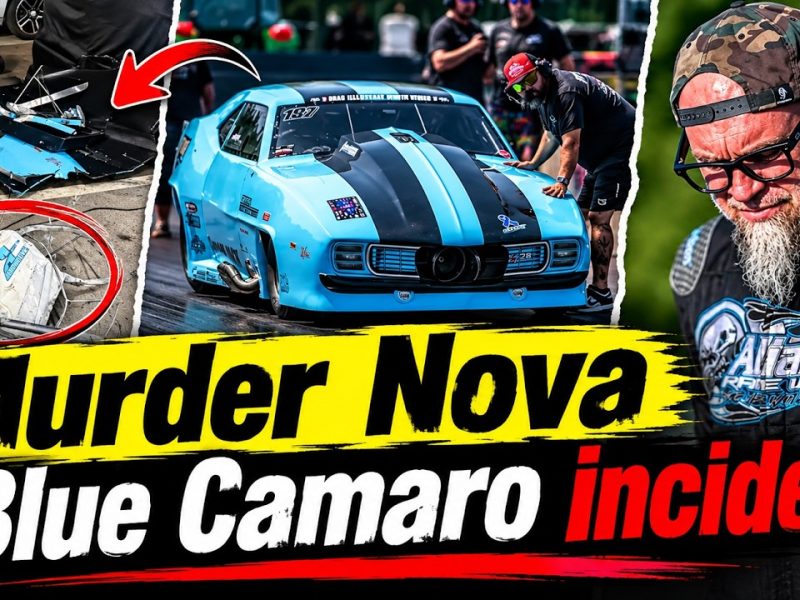
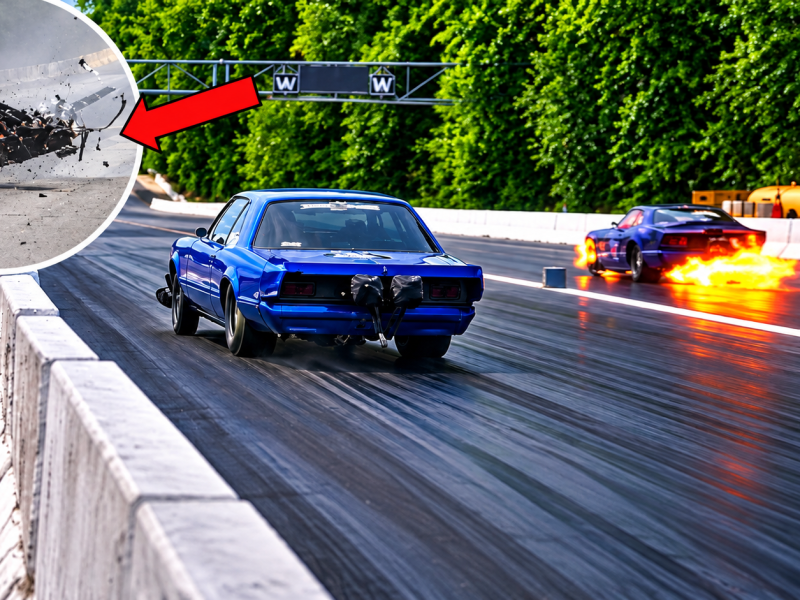
Take a look how Terry Haddock Survives Massive Funny Car Explosion and Wall Crash at NHRA Finals 2026!
The 2026 In-N-Out Burger NHRA Finals delivered a terrifying moment when veteran Funny Car driver Terry Haddock experienced a violent explosion during qualifying at In-N-Out Burger Pomona Dragstrip in California.
What began as a desperate attempt to qualify for the season-ending race turned into a frightening incident that destroyed much of Haddock’s Funny Car body and sent the machine into the wall.
Despite the severity of the explosion, Haddock survived without serious injury and was able to leave the damaged race car with assistance from the NHRA Safety Safari.
The incident immediately raised fresh questions about Funny Car safety, particularly the controversial body-retention tethers that can leave drivers with severely restricted visibility after an explosion.
Terry Haddock’s Funny Car Explodes During Final Qualifying
Saturday, November 14, was supposed to be Haddock’s opportunity to secure a place in the final elimination field of the 2026 NHRA season.
The veteran driver arrived at Pomona with a Funny Car carrying the Stars and Stripes Children’s Foundation design, supported by AMPCO Contracting.
His weekend initially looked promising.
During Friday’s opening qualifying session, Haddock recorded a respectable 4.092-second pass at 287.29 mph, placing him ninth in the provisional field.
However, rain canceled the second qualifying session, reducing the team’s opportunities to improve.
Saturday brought additional trouble.
During the third qualifying session, a split fuel line caused a fire beneath the Funny Car body. Haddock managed to stop the vehicle and escape unharmed, but the run was disqualified after he crossed the centerline.
His crew worked frantically between sessions, rebuilding and rewiring the car to prepare for one final qualifying attempt.
By the time Haddock approached the starting line for Q4, several competitors had improved their times.
He had fallen to 17th position, just outside the 16-car field.
He needed one more successful run to qualify.
Instead, disaster struck.
Violent Explosion Destroys Funny Car Body
Haddock launched for his final qualifying attempt, hoping to improve his position and secure a place in Sunday’s eliminations.
But the run ended in a massive explosion.
The blast violently damaged the carbon-fiber Funny Car body, leaving the driver surrounded by broken bodywork.
The car subsequently struck the retaining wall.
One of the most frightening aspects of the incident was that the damaged body remained partially attached to the chassis.
Instead of separating completely, sections of the body obstructed Haddock’s forward visibility.
The veteran driver was left trying to bring an extremely powerful race car to a stop while struggling to see the track ahead.
Following the incident, Haddock explained that he had never experienced an explosion quite like it, particularly one where the damaged body remained attached to the car.
The NHRA Safety Safari responded, helping Haddock exit the wreckage.
Thankfully, his safety equipment performed its intended function, and he avoided serious injury.
Two Fires and an Explosion End Haddock’s Weekend
The final qualifying explosion was not Haddock’s first major problem of the weekend.
Earlier on Saturday, the team had already dealt with a fuel-fed fire caused by a split fuel line.
That incident forced extensive repairs before the final session.
Despite the damage and limited turnaround time, the crew managed to return the car to the starting line.
Their effort demonstrated the determination of an independent Funny Car racing team competing against some of the most established operations in the NHRA.
Unfortunately, the final explosion ended any remaining chance of qualifying.
Haddock finished 17th and did not advance to Sunday’s eliminations.
His official qualifying results were:
- Q1: 4.092 seconds at 287.29 mph
- Q2: Canceled because of rain
- Q3: No official time
- Q4: No official time following the explosion
It was a devastating conclusion to a weekend that had started with genuine promise.
Matt Hagan Raises Serious Concerns About Funny Car Safety
Haddock’s accident quickly became part of a much larger conversation about the safety of modern NHRA Funny Cars.
Four-time Funny Car world champion Matt Hagan publicly criticized the body-retention tether system following the crash.
These tethers are designed to prevent large sections of a Funny Car body from separating uncontrollably during an explosion.
The intention is to reduce the danger posed by flying debris.
However, the system creates another potential problem.
When a severely damaged body remains attached to the chassis, it can obstruct the driver’s vision, interfere with the deployment of parachutes, and complicate efforts to stop the vehicle safely.
Hagan argued that drivers can effectively become trapped beneath damaged bodywork after a major engine explosion.
His concerns were echoed by other experienced racers.
Eight-time Top Fuel champion Tony Schumacher also suggested that Haddock’s accident would renew the debate surrounding the tether system.
The central question is difficult: how can NHRA prevent dangerous body panels from flying into surrounding areas without increasing the risks faced by drivers inside the cars?
Haddock’s accident has made that issue impossible to ignore.
Why Funny Car Explosions Can Be So Dangerous
NHRA Funny Cars are among the most powerful racing vehicles in the world.
Their supercharged, nitromethane-burning engines produce enormous horsepower and accelerate the cars to extraordinary speeds in just a few seconds.
That performance also places extreme mechanical stress on internal engine components.
When a major engine failure occurs, the resulting explosion can damage the supercharger, body panels, fuel-system components, and surrounding structures.
Because Funny Car bodies cover the engine and driver compartment, an explosion can cause extensive damage to the lightweight composite shell.
If the body breaks apart or becomes distorted, visibility can be compromised almost immediately.
Drivers may have only seconds to respond.
They must manage steering, braking, and parachute deployment while dealing with possible fire, smoke, and damaged equipment.
That is why the safety systems surrounding modern nitro racing are so important.
Protective driver equipment, reinforced chassis structures, fire-suppression systems, and the rapid response of safety crews all contribute to reducing the consequences of serious accidents.
Haddock’s survival is another reminder of how critical those protections can be.
Haddock Thanks His Crew and Promises to Return
Despite the disappointment, Haddock remained focused on thanking the people who supported his racing program.
He expressed gratitude for his safety, his crew, and the sponsors who helped make the Pomona appearance possible.
The weekend had special significance because the team was also supporting the Stars and Stripes Children’s Foundation through its partnership with AMPCO Contracting.
Although the final qualifying explosion prevented Haddock from competing on Sunday, the team had already welcomed guests and helped promote the foundation throughout the event.
Following the accident, Haddock acknowledged the frustration of ending the season with a damaged race car.
However, he also made it clear that his passion for drag racing remained unchanged.
The team’s published plans call for a return at the 2027 NHRA Winternationals at Pomona, scheduled for February 18–21.
That comeback will require substantial work, but Haddock has no intention of allowing the accident to define the future of his racing operation.
A Frightening Ending to the 2026 NHRA Season
The In-N-Out Burger NHRA Finals were supposed to provide an exciting conclusion to NHRA’s 75th anniversary season.
For Terry Haddock Racing, the weekend instead became a test of determination and resilience.
After overcoming an earlier fire, the team worked tirelessly to return to competition.
Then, with one final opportunity to qualify, a violent explosion ended the effort.
Haddock’s escape without serious injury was the most important outcome.
But the incident also highlighted a safety issue that continues to concern some of the sport’s most experienced drivers.
As NHRA teams prepare for the 2027 season, the debate surrounding Funny Car body tethers and post-explosion visibility is likely to remain an important topic.