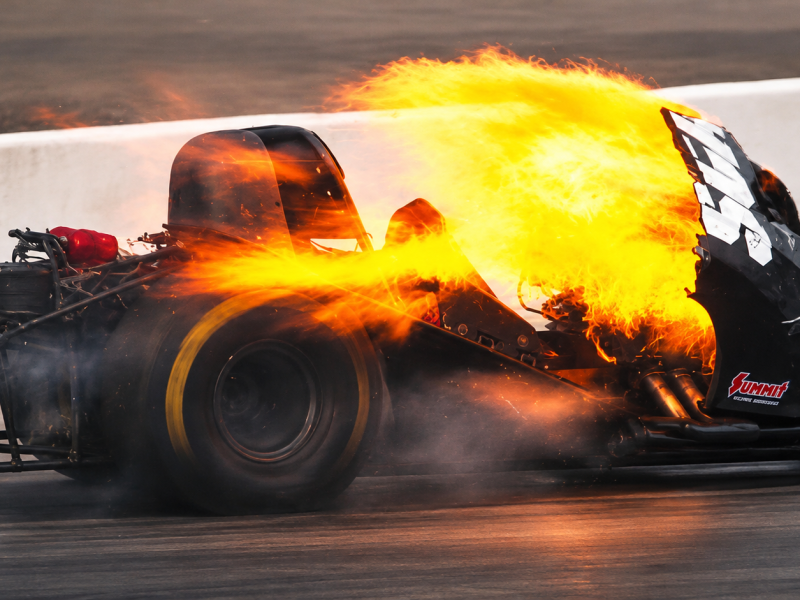
Take a look how Joel Grannas Breaks Stick-Shift World Record, Then Crashes in Heartbreaking World Cup Finals 2026 Drama!
Drag racing can deliver the greatest moment of a driver’s career and one of the most devastating setbacks within the same afternoon.
That’s exactly what happened to Joel Grannas at the 2026 Haltech World Cup Finals – Import vs Domestic.
Competing at Maryland International Raceway in Mechanicsville, Maryland, Grannas stunned the drag racing community with an extraordinary 6.274-second quarter-mile pass at 230.57 mph, setting a new H-pattern manual-transmission world record.
His record-breaking Ford Mustang, known as Peeled, features a Toyota 2JZ engine and an unconventional compressed-air supercharging system.
But the celebration was short-lived.
Later in the competition, Grannas crashed during the Stick Shift semifinals, bringing his remarkable World Cup Finals campaign to a premature end.
It was an unforgettable day that demonstrated both the extraordinary potential and the unforgiving reality of high-performance drag racing.
Joel Grannas Makes History With a 6.274-Second Quarter-Mile
The Stick Shift category at World Cup Finals 2026 produced one of the most competitive record battles in recent memory.
Some of the fastest H-pattern manual-transmission race cars in the world arrived in Maryland determined to establish new benchmarks.
Brett LaSala, driving his famous Snot Rocket Mustang, was among the leading contenders.
Nick Cole-Mann also demonstrated incredible performance during qualifying, helping push the H-pattern elapsed-time record lower.
But the biggest drama came during Sunday’s elimination rounds.
LaSala unleashed a blistering 6.280-second quarter-mile pass, setting a new benchmark.
Just minutes later, Grannas answered.
His compressed-air-powered Mustang stormed down the track in 6.274 seconds, improving the record by just six thousandths of a second.
At speeds exceeding 230 mph, the difference between the two performances was incredibly small.
Nevertheless, Grannas had accomplished something historic.
He had taken the H-pattern elapsed-time world record away from one of the toughest competitors in manual-transmission drag racing.
A Toyota 2JZ Mustang Unlike Anything Else
The record-setting Mustang is no ordinary Fox-body drag car.
Although it wears a Ford body, the powerplant comes from Toyota’s legendary 2JZ engine family.
Grannas has spent years developing high-horsepower Toyota-powered racing combinations, earning a reputation as one of the most innovative competitors in stick-shift drag racing.
His Mustang, Peeled, represents the latest evolution of that program.
The car combines a lightweight racing chassis with a heavily developed 2JZ engine and an H-pattern manual transmission.
But the most unusual component is its power-adder system.
Instead of using a conventional turbocharger, Grannas switched to compressed-air supercharging.
That decision transformed the Mustang into one of the most technically interesting drag racing machines competing in 2026.
How Compressed-Air Supercharging Helped Grannas Break the Record
Most high-horsepower Toyota 2JZ drag racing engines use large turbochargers to produce enormous boost pressure.
Grannas previously followed that approach.
However, generating the boost required for approximately 2,800 horsepower created challenges at the starting line.
Large turbochargers require substantial exhaust energy to reach their operating speed.
With a relatively small-displacement engine, that can demand extremely high launch rpm.
Grannas decided to explore another solution.
His compressed-air supercharging system, or CAS, stores highly pressurized air in bottles and delivers it directly to the engine when needed.
The system eliminates the need to spool a conventional exhaust-driven turbocharger before launching.
Grannas has explained that the arrangement can provide approximately 30 psi of boost on demand.
Another potential advantage involves gear changes.
In a conventional turbocharged manual-transmission car, boost pressure can fall during shifting.
A compressed-air system allows the engine to receive pressurized air independently of turbocharger speed.
The concept introduces engineering challenges of its own, including bottle capacity, system weight, pressure regulation, and safety requirements.
But Grannas’ record-breaking performance demonstrated that the unconventional approach could deliver extraordinary results.
From World Record Celebration to Semifinal Disaster
After setting the 6.274-second record, Grannas continued advancing through the Stick Shift elimination ladder.
A potential showdown against Brett LaSala was becoming one of the most anticipated matchups of the event.
Both drivers had already demonstrated world-record performance.
LaSala had run 6.280 seconds, while Grannas had answered with 6.274.
A head-to-head meeting between the two would have been a spectacular conclusion to the weekend.
Unfortunately, that matchup never happened.
During the semifinal round, Grannas crashed, ending his championship run.
The incident transformed what had been a historic day of celebration into a painful setback for the team.
The precise cause of the accident, the damage sustained, and any medical details should not be assumed without a verified statement from Grannas Racing or the event organizers.
What has been independently confirmed is that the semifinal crash prevented Grannas from advancing to the final.
Brett LaSala Wins the Stick Shift Championship
With Grannas eliminated following the crash, Brett LaSala continued his own remarkable World Cup Finals campaign.
LaSala had already established himself as one of the fastest H-pattern racers in the world.
His Snot Rocket Mustang had also endured a difficult period earlier in the season, making his return to championship form especially impressive.
In the World Cup Finals Stick Shift final, LaSala faced Yandro Ulloa.
LaSala secured the victory, completing an extraordinary weekend that included record-setting performance and a major event championship.
The distinction between the two achievements is important.
Joel Grannas finished the event as the H-pattern elapsed-time world record holder, while Brett LaSala won the 2026 World Cup Finals Stick Shift championship.
Both drivers contributed to one of the most memorable weekends in the category’s history.
Why the Crash Was Such a Major Setback
Modern stick-shift drag racing cars are capable of extraordinary acceleration.
At the level where Grannas and LaSala compete, vehicles can cover the quarter-mile in little more than six seconds while exceeding 230 mph.
Achieving those numbers requires a combination of engine performance, traction, chassis stability, and extremely precise driver input.
Unlike many automatic-transmission drag cars, H-pattern competitors must also execute manual gear changes while maintaining control of the vehicle.
The demands on both the car and driver are enormous.
When an accident occurs, the consequences can extend beyond visible body damage.
Teams may need to inspect the chassis, suspension, steering, drivetrain, and safety equipment before determining whether a car can return to competition.
For a highly specialized machine like Peeled, repairs can also involve custom-built components that are not readily available.
The extent of the repairs Grannas Racing will require has not been established in the verified reporting available for this article.
Grannas Racing Has Already Overcome Major Setbacks
One reason Grannas’ story resonates with racing fans is his history of persistence.
Earlier in 2026, Peeled set an H-pattern record during testing at Bradenton Motorsports Park before suffering a crash in the shutdown area.
The team rebuilt the Mustang and returned to competition.
Later, a major engine failure at FL2K created another challenge.
Rather than abandoning the program, Grannas introduced the compressed-air supercharging system and continued developing the car.
Before World Cup Finals, the team conducted additional testing at Virginia Motorsports Park to gather data and refine the new combination.
Those efforts culminated in the 6.274-second world record.
Although the latest crash represents another significant setback, the team’s previous recoveries demonstrate its commitment to pushing the limits of manual-transmission racing.
World Cup Finals 2026 Will Be Remembered for Record-Breaking Stick-Shift Racing
The 30th annual World Cup Finals delivered an extraordinary weekend for the Stick Shift category.
Multiple competitors lowered the H-pattern record, and the rivalry between Grannas, LaSala, and Cole-Mann pushed performance to another level.
For Grannas, the event produced two dramatically different outcomes.
He achieved one of the greatest milestones of his racing career, then suffered an accident that ended his championship hopes.
But the record remains a remarkable accomplishment.
Running 6.274 seconds at 230.57 mph with a Toyota 2JZ engine, compressed-air supercharging, and an H-pattern transmission represents an extraordinary achievement in drag racing engineering.