Take a look at this, Daniel Wilkerson Escapes Terrifying Funny Car Explosion as Massive Fireball Engulfs NHRA Las Vegas Run!
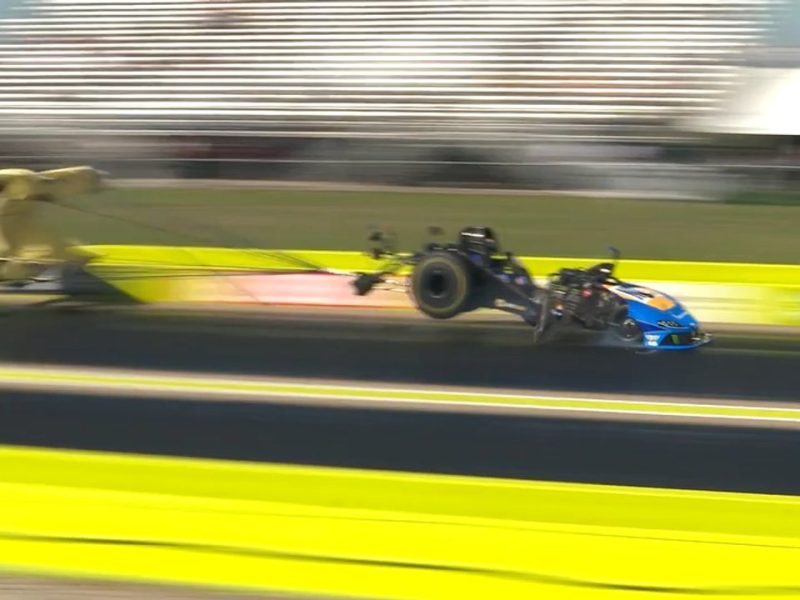
A massive engine explosion turned Daniel Wilkerson’s qualifying run into a terrifying fireball at the 2026 Mopar NHRA Las Vegas Nationals, destroying the body of his SCAG Racing Funny Car and sending the machine into the guardwall. Miraculously, the driver walked away unharmed.
The 2026 Mopar NHRA Las Vegas Nationals delivered one of the most frightening moments of the NHRA season when Funny Car driver Daniel Wilkerson experienced a violent engine explosion during Saturday’s qualifying action.
Competing at The Strip at Las Vegas Motor Speedway on October 31, Wilkerson was making a qualifying pass in his SCAG Racing Funny Car when disaster struck.
The engine erupted in a massive explosion, producing an enormous fireball that engulfed the car and sent pieces of its bodywork flying.
With flames surrounding the cockpit and the damaged chassis heading toward the retaining wall, Wilkerson fought to maintain control.
Thankfully, despite the spectacular destruction, he managed to bring the car to a stop and escaped without injury.
Daniel Wilkerson’s Funny Car Explodes During Las Vegas Qualifying
The incident happened during the third Funny Car qualifying session at the Mopar NHRA Las Vegas Nationals presented by Dodge.
Wilkerson was racing alongside J.R. Todd when his SCAG Racing machine began experiencing trouble.
According to Wilkerson, the tires had barely started spinning before the engine suddenly exploded.
Within seconds, the car was engulfed in flames as the violent blast ripped apart the lightweight Funny Car body.
The explosion was powerful enough to send body panels flying, leaving the exposed chassis sliding down the racing surface.
Wilkerson attempted to steer the damaged car away from Todd in the opposite lane, but the chassis contacted the guardwall with both its front and rear tires.
Despite the terrifying sequence, he managed to stop the car safely.
Massive Fireball Sends Flames Toward the Cockpit
One of the most alarming aspects of the incident was the enormous fireball created by the explosion.
Nitromethane-powered Funny Cars produce extraordinary horsepower, and when an engine suffers a catastrophic failure, the resulting explosion can be devastating.
In Wilkerson’s case, the blast tore the body away from the chassis, allowing flames and intense heat to sweep over the exposed cockpit.
Speaking afterward, Wilkerson described the experience as the hottest he had ever felt inside a race car.
He also expressed relief that the body separated from the chassis, believing the situation could have been even more dangerous had it remained in place.
The sleeves of his racing suit showed signs of exposure to the extreme heat.
Fortunately, his protective equipment and ability to bring the car to a stop helped him escape the incident.
Daniel Wilkerson Confirms He Is Okay After Frightening Explosion
Following the crash, Wilkerson quickly reassured fans and fellow competitors that he was physically unharmed.
“I’m fine. I’m just embarrassed,” he told reporters after the incident.
Rather than focusing on his own safety, Wilkerson immediately expressed concern for his crew, who had worked extensively to prepare the car for competition.
The driver was visibly disappointed that the team’s hard work had ended in such spectacular destruction.
However, the most important outcome was that he escaped without serious consequences.
He was also relieved that the damaged Funny Car had not collided with J.R. Todd.
For everyone watching, the confirmation that both drivers were safe was far more important than the destroyed bodywork or lost qualifying opportunity.
Quick Thinking Helps Wilkerson Avoid J.R. Todd
The explosion created an additional challenge because another Funny Car was racing in the opposite lane.
J.R. Todd was alongside Wilkerson when the engine failure occurred.
As Wilkerson fought to regain control, he made a steering correction intended to keep his damaged machine away from Todd.
That maneuver contributed to the car’s contact with the guardwall, but it also helped prevent a potentially dangerous collision between the two competitors.
At the speeds reached by modern NHRA Funny Cars, drivers have only fractions of a second to react when something goes wrong.
Wilkerson’s priority was to avoid making an already serious situation even worse.
Fortunately, Todd was not struck by the damaged car.
SCAG Racing Immediately Prepares a Backup Funny Car
While the original car suffered significant damage, the SCAG Racing team wasted little time preparing for the next challenge.
Reports from the track indicated that crew members were already heading back toward the team’s trailer to retrieve the backup Funny Car shortly after the incident.
Wilkerson explained that the spare car was nearly ready to compete and could potentially be prepared in approximately half an hour.
The team’s response demonstrated the level of preparation required to compete in NHRA’s premier nitro categories.
With engines, chassis components, and specialized equipment subjected to enormous stress, professional Funny Car teams must be ready to respond quickly to unexpected failures.
The Wilkerson team subsequently returned during the fourth qualifying session and recorded a 4.08-second pass, an impressive recovery after the earlier explosion.
A Historic Weekend for NHRA Funny Car Racing
The dramatic incident occurred during an already memorable weekend at The Strip at Las Vegas Motor Speedway.
The 2026 Mopar NHRA Las Vegas Nationals featured exceptionally quick qualifying performances as teams battled for positions in the elimination field.
Jack Beckman led the Funny Car qualifiers with a 3.836-second run, while the category made history by producing its first all-three-second 16-car qualifying field.
That achievement demonstrated just how competitive modern nitro Funny Car racing has become.
Unfortunately, the same performance levels that make the category so spectacular also place tremendous stress on the engines and mechanical components.
Wilkerson’s explosion was a powerful reminder of the dangers that accompany the sport’s extraordinary horsepower.
Why NHRA Funny Car Explosions Can Be So Violent
NHRA Funny Cars are among the most extreme racing machines in the world.
Their supercharged, nitromethane-burning engines can generate more than 11,000 horsepower, accelerating the cars to speeds exceeding 330 mph in approximately 1,000 feet.
To achieve that performance, every major engine component operates under extraordinary mechanical and thermal stress.
When an engine experiences a serious internal failure or blower explosion, the resulting pressure can violently separate components and ignite fuel.
Because the lightweight body surrounds the engine and driver compartment, a catastrophic failure can produce a dramatic fireball.
Modern Funny Cars incorporate specialized safety systems, including reinforced driver compartments, fire-resistant clothing, onboard fire suppression, and other protective equipment.
Those measures are essential in a category where mechanical failures can become emergencies almost instantly.
Wilkerson’s Escape Is the Biggest Victory of the Weekend
Although the explosion produced one of the most dramatic moments of the 2026 NHRA Las Vegas Nationals, the most important result had nothing to do with elapsed times or championship points.
Daniel Wilkerson survived.
His Funny Car suffered a catastrophic engine failure, the body was blown apart, and the damaged chassis struck the retaining wall.
Yet the driver was able to stop the car, exit safely, and speak with reporters afterward.
The quick response from his crew and the availability of a backup machine also showed the resilience of a professional NHRA racing team.
For drag racing fans, the incident was another reminder that the sport’s greatest competitors face extraordinary risks every time they climb behind the wheel.
The explosion was terrifying, the fireball was enormous, but the most important news was that Daniel Wilkerson walked away.